AU-DELÀ DE LA VILLE: JONAS MOËNNE

In Europe, the majority of the population lives in cities, with only a quarter living in rural areas. The contrast is even more striking in Belgium, where 98% of the population is urban and just 2% rural. Yet in terms of the distribution of space, the countryside and its arable land account for the vast majority of European and global territories. Although marginalised, these areas feed us, sustain ecosystems, and simply make life on Earth possible. It is this tension that Beyond the City explores, inviting us to deconstruct our urban-centred perspective and turn our attention towards other spaces – nature, rurality, the agricultural world – that the city has rendered invisible. In his solo exhibition, artist Jonas Moënne brings to light the complex relationships between city and countryside, nature and culture, as well as humans and non-humans.
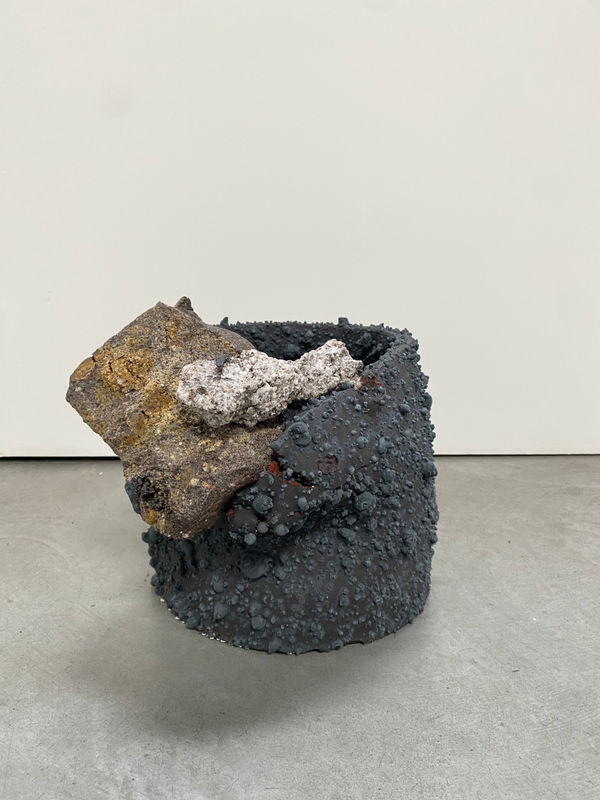
Far removed from passing trends, the multidisciplinary artist draws on knowledge passed down through generations, his profound understanding of materials (whether granite, clay, kaolin, quartz, glass, wool or plant sediments), and his interest in myths, tales and folklore, offering us a journey through the multiple forms these intertwined and contradictory relationships can take. At times an alchemist, pushing the limits of molten matter; a craftsman, reworking and diverting the codes of tapestry; or a sorcerer, concocting plant decoctions to create coloured inks, Jonas Moënne develops a singular visual vocabulary, seemingly generated by the environments he explores. There is indeed something of an Arte Povera 2.0 in the artist’s attention to the materials he employs, whether natural or reclaimed, resulting in works whose deliberately raw facture is at times biomorphic, often minimalist, and entirely at odds with any form of mannerism. Rather than imposing a preconceived form upon matter, the artist instead collaborates with it in a kind of virtuous co-creation, in which human and non-human cultures engage in dialogue to create meaning.
The exhibition thus constructs a dialogue between different realms: animal (Les Veaux d’Or, La Future Orléans), vegetal (La Future Orléans, Érosion), fungal (Érosion, Le Chant des Lucioles), mineral (Érosion, Cairn), as well as climactic (Les Saintes Glaces). Their divergent temporalities intertwine and respond to each other: mineralic deep time, the long time of fungi and plants, and the short time, on a human scale, of global warming and the animal kingdom, particularly when it has been genetically modified by humans.
From this temporal perspective emerges the outline of an archaic and powerful nature, which passes with a kind of majestic indifference through the ravages inflicted upon its more recent forms, particularly animal and human ones. Perhaps it is nature itself that warns us, through the network of meanings created by the titles of the works, with their sometimes biblical, sometimes literary and poetic connotations, of the fatal fate reserved for those who have the hubris to forget where they come from: the mother’s womb, organised matter, bacteria and fungi, the agricultural world that feeds us, the planet Earth... To them, the exhibition reminds us that nature, in its mineral, fungal or bacterial forms, will have the last word.
Text | Oriane Petteni, philosopher of nature
-
 Jonas Moënne, Cairns , 2026
 -
Jonas Moënne, Cairns , 2026
-
Jonas Moënne, Cairns , 2026
-
Jonas Moënne, Cairns , 2026
-
Jonas Moënne, Cairns , 2026
-
Jonas Moënne, Cairns , 2026
-
Jonas Moënne, David & Goliath, n°13, 2023
-
Jonas Moënne, David & Goliath, n°2, 2020
-
Jonas Moënne, Érosion , 2026
-
Jonas Moënne, Érosion , 2026
-
Jonas Moënne, Érosion , 2026
-
Jonas Moënne, Érosion , 2026
-
Jonas Moënne, Érosion , 2026
-
Jonas Moënne, Érosion , 2026
-
Jonas Moënne, Érosion , 2026
-
Jonas Moënne, Érosion , 2026
-
Jonas Moënne, Érosion , 2026
-
Jonas Moënne, Érosion , 2026
-
Jonas Moënne, La Future Orléans , 2025
-
Jonas Moënne, La Future Orléans , 2025
-
Jonas Moënne, La Future Orléans , 2025
-
Jonas Moënne, Le Chant des Lucioles, 2024